How to organize a small desk without covering the work surface
Listing research and a worksheet for your own measurements, not a hands-on test. Product links may earn us a commission from qualifying purchases.
A small desk can look tidy and still be awkward to use. The problem is often not the total surface area. It is that stationery, storage and little decorative pieces divide the remaining space into narrow patches that do not hold the notebook, keyboard or project in front of you.
A more useful plan starts with one protected rectangle. Keep that working area intact, then decide what deserves space around it.
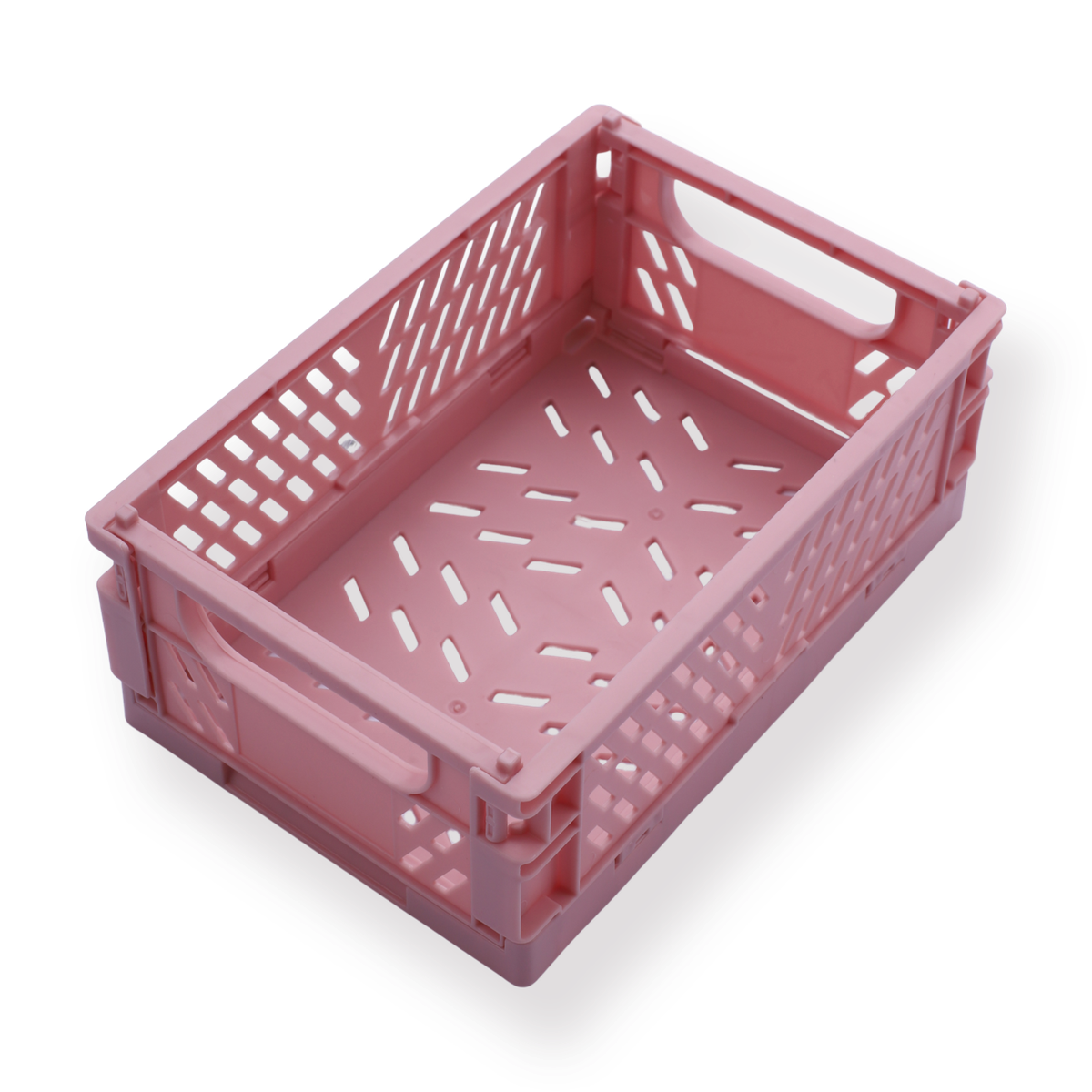
Foldable Mini Storage Crate — Pink
Retailer photograph of the pink variant. Its listed 150 × 98 × 57 mm dimensions are a starting point; the axes and in-use clearance still need checking. No comparative scale or hands-on fit is implied.
Start with one protected work rectangle
Clear the desk and place the main thing you normally work with in the centre: your notebook, laptop, keyboard, sketchbook or current craft project. Measure the smallest rectangle that lets that setup sit flat without overlapping an accessory.
Write down:
- protected work width: ______
- protected work depth: ______
- free zone on the left: ______ × ______
- free zone on the right: ______ × ______
- shelf or off-desk zone: ______ × ______
This is a personal planning measurement, not an ergonomic standard. The important part is that the work rectangle stays contiguous. Two disconnected scraps of empty surface are not a substitute for one usable area.
Measure zones, not the whole desk
A desk may have enough total area for several organizers while still leaving no practical place to work. Test each accessory against a real zone at an edge or on a shelf.
Use three labels:
- Ruled out: a known dimension is larger than the available zone in both orientations.
- Provisional: the supplied numbers fit on paper, but an axis, open state or access path is still unknown.
- Unresolved: the listing does not provide enough information to make a defensible placement decision.
These labels are more honest than “fits” when a retailer supplies dimensions without naming width, depth and height.
Record every state that changes its space
An accessory can occupy different amounts of space during the day. Give each state its own row:
| State | What to record |
|---|---|
| Stored or folded | Only the dimensions explicitly supplied for that state |
| Formed or expanded | A separate set of dimensions; do not substitute the folded size |
| Loaded | Any extra width or height created by pens, cables or the item being held |
| In use | The room needed for a lid, phone angle, tape pull, controls or your hand |
If the listing does not supply one of these measurements, leave it unresolved. Do not turn a product photograph into a scale drawing.
Give the nearest space to the things you actually use
Sort desk items by reach frequency before assigning them a zone:
- Daily items can earn a near-hand place outside the protected rectangle.
- Occasional items can sit at a back corner, outer edge or nearby shelf.
- Rarely used refills, spare pens and decorative extras should not occupy the main surface by default.
A container does not reduce clutter if it permanently holds things you rarely reach for.
Run a two-orientation paper test
For an accessory with a candidate pair of dimensions a × b and an available zone W × D, test both orientations:
- a ≤ W and b ≤ D; or
- a ≤ D and b ≤ W.
A pass only means the two rectangles can fit on paper. It does not settle height, axis order, cables, open angles or hand movement.
Cut a paper rectangle to the candidate dimensions and place it in the intended zone. This makes it easier to see whether the item would pinch the work rectangle, cover a drawer, block a screen or sit where your hand needs to move.
Worked example: a 180 × 120 mm side zone
The following is a calculation example, not a recommended desk size or a claim that these products were tested.
Suppose a desk has:
- a protected work rectangle of 450 × 300 mm; and
- a side zone of 180 × 120 mm.
Current Stationery Pal listings give these measurements:
| Candidate | Listing measurement | Paper result for 180 × 120 mm | What remains unresolved |
|---|---|---|---|
| Foldable Mini Storage Crate — Pink | 150 × 98 × 57 mm | The 150 × 98 pair is provisionally placeable, leaving 30 mm and 22 mm along the two tested spans | The listing does not name the axes, so this is not a certified footprint |
| Foldable Piggy Phone Holder | 12 × 6 cm | The supplied pair is provisionally placeable | The open angle, attached phone and full in-use envelope are not supplied |
| Kokuyo Pastel Cookie Expandable Pen Case | 210 × 93 × 27 mm before expansion; 210 × 93 × 67 mm after expansion | If 210 × 93 mm is the surface span, it is ruled out in either orientation because 210 mm exceeds both zone sides | The listing does not label the axes, so the changing 27-to-67 mm value should not automatically be called depth or height |
| Foldable Pen Holder — Bear | Formed size 114 × 89 mm | The supplied pair is provisionally placeable | The pair may include height rather than two base dimensions; the collapsed size and pen-access clearance are not supplied |
| Retro Cassette Tape Dispenser with Pen Holder | 17 × 5 × 11.5 cm | A 17 × 5 cm pair would pass the paper screen | The axes are not labelled, and using the tape or reaching for pens needs space beyond a static rectangle |
This comparison shows why “passes the paper test” is not the same as “guaranteed to fit.” A provisional result tells you what to verify before giving an item permanent desk space.
Choose by function before shape
The examples solve different problems:
- A foldable crate groups several loose items but creates a container that can collect things you do not use.
- A phone stand can move a phone off the work rectangle, but the device and viewing angle determine the real in-use space.
- An expandable case keeps supplies together and can be moved off the surface when the work changes.
- A formed pen holder keeps tools visible and near at hand, but loaded pens may affect access and stability.
- A combined tape dispenser and pen holder saves a second object only if both functions belong in the same reach zone.
Choose the problem first. Then compare the item’s stored, formed and in-use states with the zone that problem actually occupies.
Try a reversible layout before committing
For one normal work session:
- Mark the protected rectangle with removable paper or low-tack markers.
- Place only daily-use items in the near-hand zones.
- Use paper templates for accessories whose footprints are not yet confirmed.
- Move occasional items to an outer edge or shelf.
- Notice which access paths cross the protected rectangle.
- Keep uncertain items provisional until you measure them in their real state.
The goal is not an empty desk. It is a desk where the cute details have a place without taking over the task in front of you.
Small-desk planning worksheet
| Item | Reach tier | Stored/folded size | Formed/expanded size | In-use space or movement | Zone | Decision |
|---|---|---|---|---|---|---|
| — | daily / occasional / rare | — | — | — | — | ruled out / provisional / unresolved |
| — | daily / occasional / rare | — | — | — | — | ruled out / provisional / unresolved |
| — | daily / occasional / rare | — | — | — | — | ruled out / provisional / unresolved |
| — | daily / occasional / rare | — | — | — | — | ruled out / provisional / unresolved |
Before you add one more desk accessory
- Is the protected work rectangle still intact?
- Does this item solve a daily problem, or only add another container?
- Are the listing dimensions tied to labelled axes?
- Does it fold, expand, open, hold a device or need a hand path?
- Have you tested both orientations?
- Can an occasional item move to a shelf or drawer?
- Is the decision ruled out, provisional or genuinely resolved?
For colour-led styling ideas, read A soft-colour desk, without the clutter. For the current stationery and organization edit, browse Desk & paper finds.
These suggestions are based on retailer listings and planning measurements, not hands-on testing. Product links may earn Cute & Found a commission from qualifying purchases, at no extra cost to you. Retailers handle checkout, shipping and returns.